
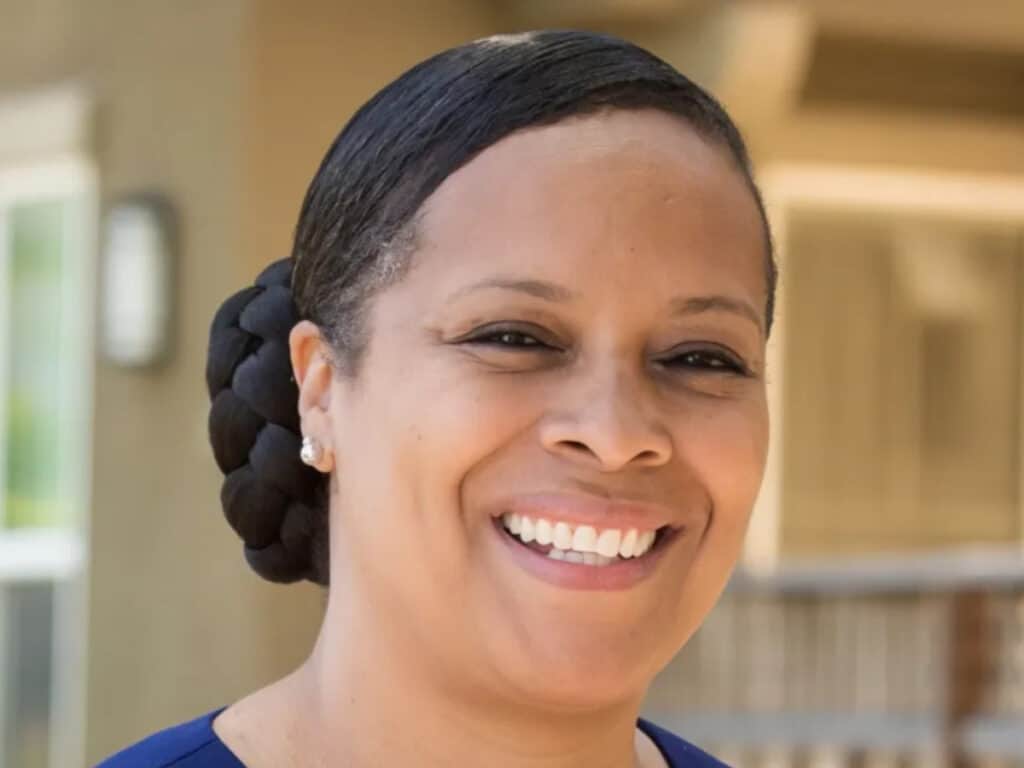
Lisa Gauthier is no stranger to making decisions on the coastline. She’s a founding member of OneShoreline and currently serves as a San Mateo County Supervisor and Board Member of the San Francisco Bay Restoration Authority.
What is your personal relationship with flooding and sea level rise?
I live in the Gardens area of East Palo Alto, which experienced floods in 1998 and 2012. My best friend’s house is near the San Francisquito Creek levee and in both floods, water overtopped the banks and entered their home. They lost everything. After the 2012 flood I had just been elected and realized that I needed to do more than just put on rain boots – I needed to protect my community. It just makes sense to me to be on the front lines helping with solutions, especially for seniors and those who cannot afford to raise their homes or have some kind of personal way of preparing for sea level rise.
What has your work in this space looked like?
I’ve been engaged with sea level rise work now for almost 14 years! I was on the East Palo Alto City Council for 12 years where I was assigned to the San Francisquito Creek Joint Powers Authority as an alternate. One of our primary goals was to address local flooding, so we were working on the ‘SAFER Bay’ solution, which is a comprehensive shoreline flood protection project in Menlo Park and East Palo Alto.
Read more about the SAFER Bay project here.
One thing that’s cool about the SAFER Bay project is that its impacts are already being felt even though it’s a long-term strategy for sea level rise. For parts of the shoreline where we’ve already implemented solutions, flood insurance premiums have already gone down. People received rebates in Year 1 because their homes were safer!
I am also a founding member of OneShoreline, which was created to coordinate flooding solutions across San Mateo County’s twenty cities. Its status as a special district gives it an ability that’s unique in California – it can finance and coordinate flood resilience projects across an entire county with some agility.
OneShoreline allows us to have proactive, collaborative conversations across jurisdictions, which is essential so that solutions are consistent. We really do need to do this collaboratively.
Check out more about OneShoreline’s role in sea level rise planning here.
What inspires you and how are you putting that into action?
Former San Mateo County Supervisor Dave Pine is a name a lot of people know, and I was inspired by him when we served on the JPA together. He did significant work to elevate climate adaptation and he understood how to make the gears of government turn to get things done. As a leader, he fought for climate justice and ensured that San Mateo County invested in OneShoreline so it wouldn’t become an afterthought.
My own best skills are passion and a willingness to learn. I am a lifelong learner and share what I learn with others to continue the work. I focus a lot on my district’s most vulnerable residents – there are mobile home parks in Belmont and Redwood City that flood almost every year. When I learned that pumps were broken and there was finger-pointing about responsibility, I pushed to get funding to fix them. You can’t just say “it’s not my problem.” You must advocate for those who don’t know how to advocate for themselves.
Are adaptation efforts resonating?
The most important challenge is ensuring everyone understands that we are the most vulnerable area for sea level rise in all of California – that it is a real threat. When you talk to people about how their assets are going to be impacted, that resonates. So does hearing from someone who has experienced flooding. I think field trips to see levees or marshland restoration projects also help people understand the risk. When you stand out on the levee in East Palo Alto, you can see the tops of houses below and you understand that the levee is the only real thing between the water and those homes.
What’s the next phase of this work?
My vision for the Bay in 10 to 20 years is a safer Bay with healthy ecosystems where people enjoy the scenery. It is our job to keep the environment clean because we are borrowing this earth from future generations. For one thing, we should be seeking help from locally impacted businesses because they will benefit from and be protected by our solutions. I am also excited about climate resilience districts because adaptation solutions can be expensive and some smaller cities lack resources. I am also encouraged that BCDC (the Bay Conservation and Development Commission) and OneShoreline are collaborating on a shoreline adaptation strategy.