
Cities across the Bay are preparing for El Niño, which is expected to bring extreme high tides and powerful storms. It will also give us a preview of what everyday sea levels and storms could look like in just a few decades. More flooding and sea level rise also means more trash and more harmful chemicals in the Bay.
The time for the Bay to adapt to climate change is now, but it will require funding to implement needed adaptation projects. That’s why one of Save The Bay’s main advocacy priorities is to ensure that state and federal funding flows to the Bay. Meaningful investments mean Bay communities are healthier and more resilient to these changing conditions.

Adapting Will Require Local, State, and Federal Resources
We’ve long known that getting these projects built will take funding from every level of government. That’s why Save The Bay prioritizes advocating for new resources. In 2016, we led the campaign to pass Measure AA, which is investing $500 million in shoreline restoration projects that will help buffer communities from rising sea levels. New state and federal programs that we supported have started to bring additional resources to the Bay. These include California’s Proposition 4 and a program within the US EPA that Save The Bay helped create.
Californians understand there is an urgent need for more project funding, so in 2024, voters passed Proposition 4, a $10 billion climate bond. The climate bond includes over $1 billion for projects that strengthen coastal resilience, and 40% of funds will go toward projects that benefit disadvantaged communities. Save The Bay and our partners advocated for this coastal resilience funding, and we helped secure at least $85 million for projects that support the Bay. We’re now working to make sure this money is invested quickly to stay ahead of the impacts of sea level rise.
Save The Bay also worked with federal representatives to pass the San Francisco Bay Restoration Act, which created the US Environmental Protection Agency’s (EPA) San Francisco Bay Program in 2022. This year, the EPA San Francisco Bay Program awarded $82 million to 20 projects that will advance habitat restoration, prevent pollution, and improve the water quality of the Bay.
While there’s still a lot to do and more funding will be needed, we are excited about the many investments being made to build a healthier, more resilient Bay. Below are some examples of recent projects that received funding from Prop 4 and the US EPA’s San Francisco Bay Program.
Habitat Restoration and Climate Adaptation
Save The Bay and our partners have been working to protect and restore 100,000 acres of tidal marsh, and now we’re also promoting ways to use nature to provide flood protection. This approach, called nature-based solutions, has many benefits. It helps communities adapt to climate change, protects wildlife habitat, and improves water quality, and expands public access to the Bay.
Prop 4 and the EPA’s San Francisco Bay Program made significant investments this year for projects that advance large-scale nature-based solutions for both habitat restoration and flood protection. Two areas on opposite sides of the Bay—North Bay and South Bay—are making strides with support from Prop 4 and the EPA’s San Francisco Bay Program.
The South Bay Salt Pond Restoration Project is the largest tidal wetland restoration project on the West Coast and will restore over 15,000 acres of former salt ponds, create habitat for wildlife, provide flood protection, and expand recreation. A project of this size requires significant funding to implement, and the EPA’s San Francisco Bay Program is helping. It invested $3 million to restore 275 acres of tidal marsh in Pond A1 in Mountain View. This project will also include new Bay Trail and is designed to protect Shoreline Park from erosion.
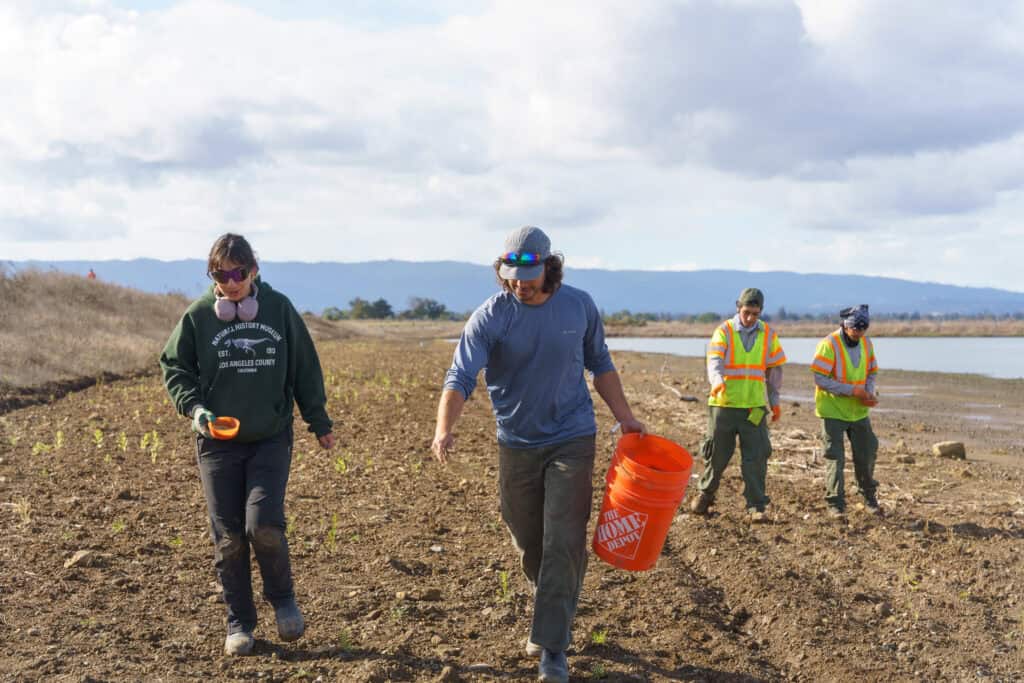
In the North Bay, the Goat Island Tidal Marsh Restoration and Public Access Project will restore 80 acres of diked marsh to tidal marsh. The project also aims to enhance the transition zone, which is crucial for aquatic life, migratory birds, and endangered species. This restoration project will act as a natural water filter for Suisun Bay and San Franscisco Bay, while also expanding public access by creating trails and boardwalks. Solano Land Trust was awarded $595,000 fromProp 4 and $3.99 million from the EPA’s San Francisco Bay Program to support these goals.
Pollution Prevention
Storms and flooding from this winter’s El Niño will wash more trash and harmful chemicals into the Bay. That’s because stormwater is one of the largest sources of Bay pollution. Preventing pollution from entering the Bay is necessary for thriving ecosystems and healthy shoreline communities. The City of San José and the Port of Oakland received grants from the EPA’s San Francisco Bay Program to do just that.
The City of San José was awarded $3.16 million to help execute its green stormwater infrastructure implementation plan. This will include projects such as completing green streets with rain gardens, bioswales, and other “nature-based” stormwater management to reduce polluted stormwater from reaching the Bay.
The Port of Oakland was awarded $5 million to fund the installation of four trash capture devices that will help prevent more than 4,700 gallons of trash from entering the Bay. Most of this trash is swept off nearby neighborhoods, streets, and highways by stormwater when it rains. Save The Bay has worked to ensure that cities and Caltrans meet their obligations under the Clean Water Act to keep street litter out of the Bay, and devices like these are one way to do that.

Bay Trail
Planning for sea level rise also includes adapting our trails and ensuring the public still has safe access to the shoreline. Save The Bay is advocating to complete the unfinished 150 miles of the 500-mile Bay Trail and ensuring that current trails are climate resilient. Prop 4 is already helping close gaps. The San Mateo County Transportation Authority received $2.25 million to plan and complete permitting to close a 2.5-mile priority gap of the Bay Trail near San Francisco International Airport.
This is only the beginning
There is a long way to go to achieve regionwide resilience, but we are seeing the voter-passed climate bond and EPA’s San Francisco Bay Program fund crucial projects that will improve habitat, protect Bay Area communities from flooding, and expand access to the Bay. Save The Bay will continue to advocate to maintain and expand these funding programs, as we work to build a Bay that is resilient, healthy, and accessible for all.
Learn more about the full set of investments made by the EPA’s San Francisco Bay Program and Prop 4 here.