It’s easy to miss good news coming out of Washington, but tucked in among the recently passed government funding bills was a glimmer of hope for the health of the Bay. While the Trump Administration continues to roll back the Environmental Protection Agency’s authority, Save The Bay has worked for years to create and grow a program that directly invests in cleaner water, improved habitat, and better access to a healthy San Francisco Bay. This year that program is poised to make an even bigger impact, and here’s how.
History
In addition to administering national laws like the Clean Water Act and Clean Air Act, the EPA also has targeted programs that focus on local pollution and environmental health for a specific region. These “EPA Geographic Programs” include efforts to protect and restore the Chesapeake Bay, Puget Sound, and the Great Lakes, among others. Many of these geographic programs have existed for decades and have enabled the federal government to invest millions of dollars in protecting and restoring these important watersheds.
Despite being the largest estuary on the west coast and home to more than 7 million people, the San Francsico Bay was left out among that group for a long time. In 2008, recognizing that the EPA should be doing more to improve the health of our Bay, former Senator Dianne Feinstein began directing small amounts of funding to the EPA to improve SF Bay’s water quality. Then in 2022, Save The Bay worked with former Rep. Jackie Speier and Speaker Pelosi to pass the San Francisco Bay Restoration Act, which formally created the EPA’s San Francisco Bay Program.
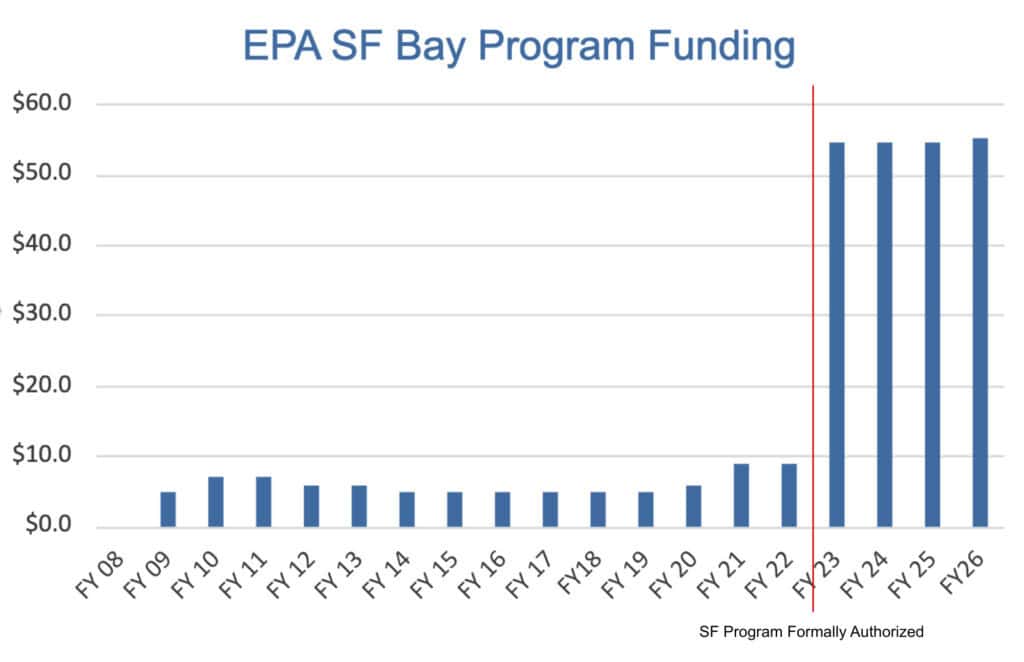
The impact of that was immediate. The small amounts of annual funding that Sen. Feinstein had secured grew significantly, and the EPA gained new authority to use that money in ways that promote a healthy Bay. Now the EPA’s San Francisco Bay Program invests more than $50 million every year in 11 “priorities” that include large scale tidal marsh restoration, reducing forever chemicals like PFAS, eliminating nutrient pollution that feeds toxic algae blooms, expanding nature-based green stormwater infrastructure, and promoting important habitat features like eelgrass and native oyster populations.
Recent Budget News
If this program was established in 2022, why are we talking about it now? Unfortunately, as we’ve seen in many examples, the current administration has shown a willingness to cut funding and undermine programs that it doesn’t support – particularly ones that address environmental impacts to human health and our communities. In addition, federal funding that specifically benefits the San Francisco Bay Area has been a target for reductions as we’ve seen with proposals to limit funding for the Presidio, important local health care programs, and investments in environmental justice and protections from natural hazards for disadvantaged communities.
The EPA’s San Francisco Bay Program has not been immune from that. The Administration’s initial budget proposal this year for the EPA’s San Francisco Bay Program was to cut it by around 75%. In fact, the SF Bay Program was one of only two EPA geographic programs proposed for a cut (along with Puget Sound), but our local program was slated to lose the most.
Save The Bay continues to work to protect and grow this program, and we coordinated with Representative Huffman and Senators Padilla and Schiff, along with our partners at a national advocacy group called Restore America’s Estuaries, to push back on these proposed cuts. When the final federal funding bill for the EPA was revealed in January, we were excited to see that not only was the program not cut this year, but it actually received a slight increase in funding!
Impact
With the SF Bay Program now fully funded for the year, the EPA is moving ahead with awarding grants to projects around the Bay. We’ll know later this year where that money will go, but we can look at what the program has funded in the past to get a sense of the type of impact it will have.
In Richmond, the EPA funded the removal of the Terminal Four Wharf, the largest derelict structure leaching toxic creosote into the Bay. That wharf has now been removed, and the area is being restored to its natural habitat.
In Hayward, the EPA is funding an innovative new approach to flood protection and water quality improvement with the First Mile Levee. This “horizontal” levee will provide flood protection against sea level rise, while also allowing for the removal of nutrients from treated wastewater.
In the South Bay, the EPA is funding the San Tomas Aquino/Calabazas Creek Restoration Project. This project will improve flood protection in San Jose, Santa Clara, and Sunnyvale by improving four miles of creeks and restoring 1,800 acres of tidal marsh habitat.
In San Francisco, the EPA is funding new urban green infrastructure in the Sunnydale and Yosemite Creek watersheds in the City’s southeast corner. Nature-based green stormwater infrastructure will reduce pollution in the creeks and the Bay and bring greenery into neighborhoods that suffer from a lack of access to nature.
With funding secured for the year, more impactful projects like these throughout the Bay Area will be able to move forward. Learn about all the projects that the EPA’s SF Bay Program has supported here.
Road Ahead
Even with this year’s funding in place, we can’t back down in our defense of this program. As we’ve seen, funding is not guaranteed from year to year, and we’ll likely have to remain vigilant to protect and grow the program in the upcoming federal budget. Luckily our representatives in Congress are very engaged and have made this a high priority. Senators Padilla and Schiff have helped keep the funding stable, and Representative Huffman is leading an effort to increase that funding even further.
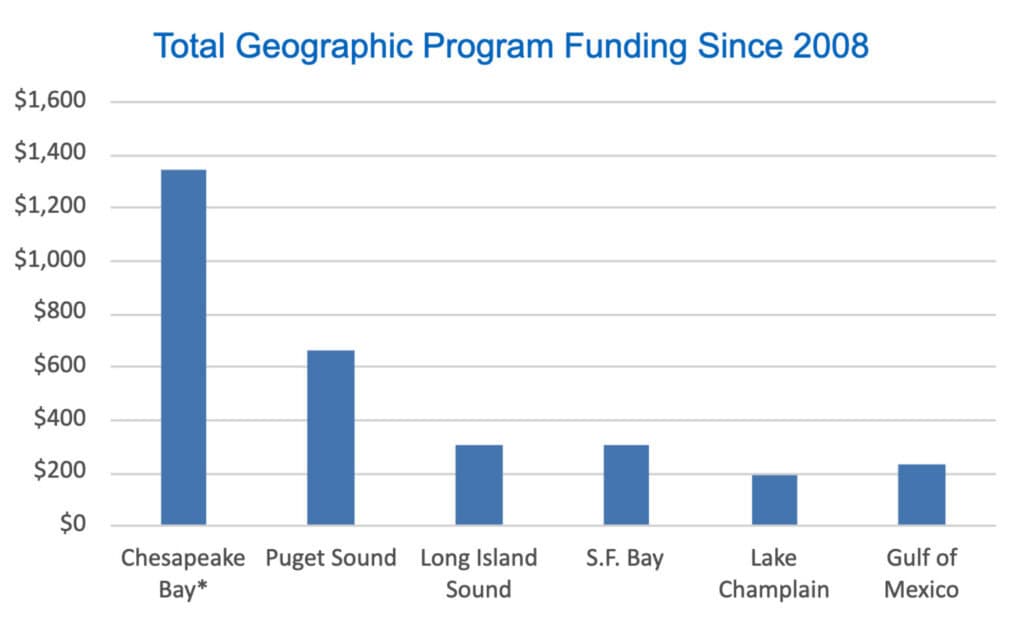
Despite recent increases in funding, SF Bay still trails other nationally significant estuaries in total federal investment.
The San Francisco Bay remains at risk from pollution, habitat destruction, and increasing challenges from sea level rise. To protect and restore it, we need coordination, funding, and partners from all levels of government, including the EPA. Thanks to the strong support of our congressional leaders and partners here and nationally, we were able to keep that support in place, and will continue to maintain and grow it going forward.